.png)
10/26/25 homily for Sunday conventual Mass
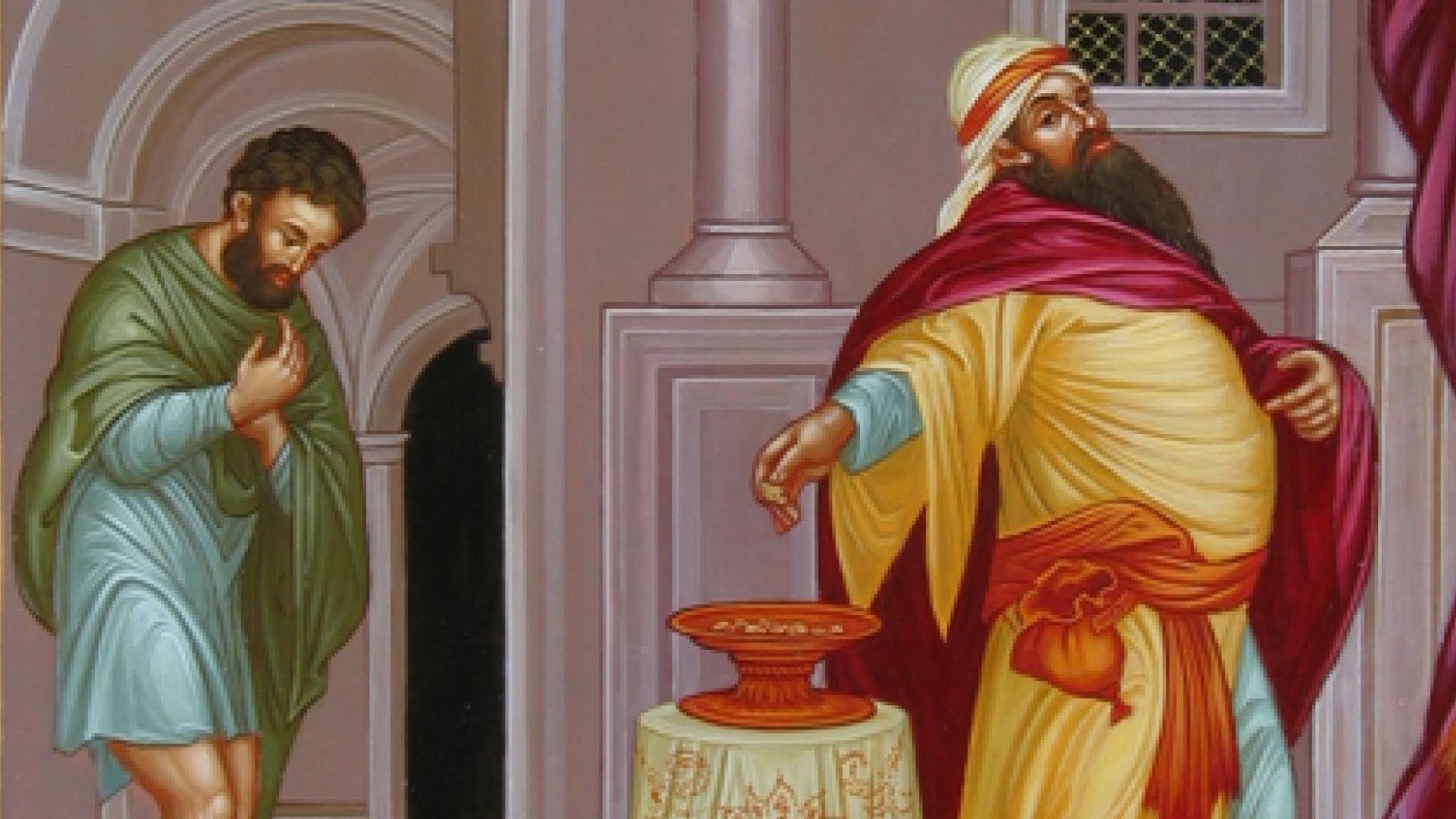
“O God, I thank you that I am not like the rest of the monks, fat, weak, inflexible. I lift weights four times a week and do pull ups for fun.” I certainly sympathize with the Pharisee from the parable. The Pharisee takes the Law seriously and to a large degree does live in accord with its commands. He knows that living in accord with the Law benefits him and from that perspective is thankful that he is not like that loser tax collector and others that fall short of adhering to the Law. Analogously I take my physical health seriously and its successful cultivation profits me greatly and I’m indeed grateful to God that he has blessed me with it. Both the Pharisee’s prayer and the first line of this homily are factually true and sincere yet they do not promote the justification or well being of the person speaking it.
In most any weight room you find mirrors. In the best gyms, like Priory’s, you’ll frequently find an entire wall empaneled with mirrors. These mirrors can be used to admire oneself, compare oneself to other lifters, or furtively observe others. Alternatively some people never really notice them or use them. However, their actual purpose is to help you learn about your own shortcomings. They help you notice if your left arm is not getting high as your left, seeing exactly where your bar slows down, or observe how far your hips are shooting back. The gym bro knows that self satisfaction and comparing yourself to others does not make you stronger. What does make you stronger is zealously looking for weaknesses, admitting them and then looking for help to eliminate them.
Being strong, like being healthy, is not about being better than others or about fulfilling certain quantitative standards or completing some checklist. Health is simply the prudent stewardship of the body that has been entrusted to you by God and the blessings that have accompanied your life. The body’s well being is not ascertained by comparing it to others nor by rejoicing at its present state. Instead it needs to be examined for deficiencies on a regular basis and some sort of treatment to address those identified disorders needs to be sought. The mirror is simply one of those tools available in the domain of health to help identify irregularities and see if any practices implemented to address them have been effective in resolving or ameliorating them.
While the chapel of the body has mirrors to facilitate self examination, the gym of the soul, the church, has confessionals for that same purpose. In fact confessionals are even better than mirrors since they not only help expose infirmity, but also simultaneously serve as a place of healing. In the parable the tax collector also experienced healing in the Temple. The tax collector received justification because in his prayer he only focused on his relationship with the Lord and how he had failed in responding to His love and providence. You can just be like the tax collector by doing an examination of conscience and making an act of contrition every day. In fact you can be even better than the tax collector by frequenting the sacrament of confession on a regular basis.
St. Bernard of Clairveaux defined humility as the love of truth, especially the most difficult truths about one's self. Both an examination of conscience and confession help foster growth in humility. Confession is especially effective at fostering humility because it obliges you to give your sins a physical manifestation. (It is a very real phenomenon that I have observed in the confessional that penitents will just start crying when they actually utter their sin even though they had been composed while merely thinking about their sin.) We here at the abbey and St. Anselm’s want you to go to repent of your sins, grow in humility and heal your souls which is why confession is available before every Sunday Mass and multiple times throughout the week. Not only that but we just go until no is left in line. We don’t turn you away even if we have been at it for two hours.
I was reading an article from an Argentinean Catholic blog that related the horror the author experienced when traveling in the US in the 90’s and he observed that the entire congregation of many hundreds came up to receive communion even though the parish bulletin only one half hour once a month for confessions. The author further lamented the fact that such Yankee imperialist practices had also started to appear in some parishes of his own country. I can attest that I have had similar experiences myself. I have attended Masses in rural Mexico where less than 10% of the congregation will receive communion to a large degree because access to confession is so limited. The non reception of communion is a beautiful way to acknowledge one’s identity as a sinner and thus concretely act like the tax collector. Correspondingly I have heard Spanish podcasters comment favorably on the Yankee imperialist practice of receiving a blessing when one is unable to receive communion as another way to humble oneself.
You are actually obliged by canon law to go to confession once a year. This legislation makes perfect sense if you compare it to the care of the body. You are supposed to see the doctor and get your bloodwork done annually even if you don’t feel pain or sense any illness. Similarly you go to confession annually for that most basic level of self examination. As someone who has heard a few thousand confessions I will say that practice makes perfect and people who confess less frequently than multiple times a year kind of lack humility in the way St. Bernard defined it as “love of truth, especially the most difficult truths about one's self” simply because they don’t know themselves that well.
The Pharisee is so obsessed with comparing himself to others and external metrics that he doesn’t know himself. On the other hand the tax collector in the parable knows himself and it is because he confesses his sinfulness that he knows himself. You too can come to know yourself by confessing your sins.